ITI vs Diploma: Which Is Better for Your Career?

ITI vs Diploma: Which Is Better for Your Career?
If you have finished Class 10 and are thinking about what to do next, you may be hearing two common options: ITI and Diploma.
It is easy to turn this into a simple 'which is better?' question. In reality, they are different paths. ITI is generally more trade- and skill-focused, while a polytechnic diploma usually provides broader technical education in an engineering or related discipline.
Neither route is automatically better for everyone. The better choice is the one that fits the kind of work and career path you want.
ITI vs Diploma at a glance
ITI: focused vocational or trade training, with strong practical and workshop-oriented learning. Course duration varies by trade.
Diploma: broader technical education in a discipline such as Mechanical, Electrical, Civil or Electronics. Many conventional polytechnic diploma programmes are three years after Class 10.
What is ITI?
Under the Craftsmen Training Scheme, DGT describes ITI training as vocational training intended to build skilled workers for industry. The current CTS framework includes 169 NSQF-compliant trades.
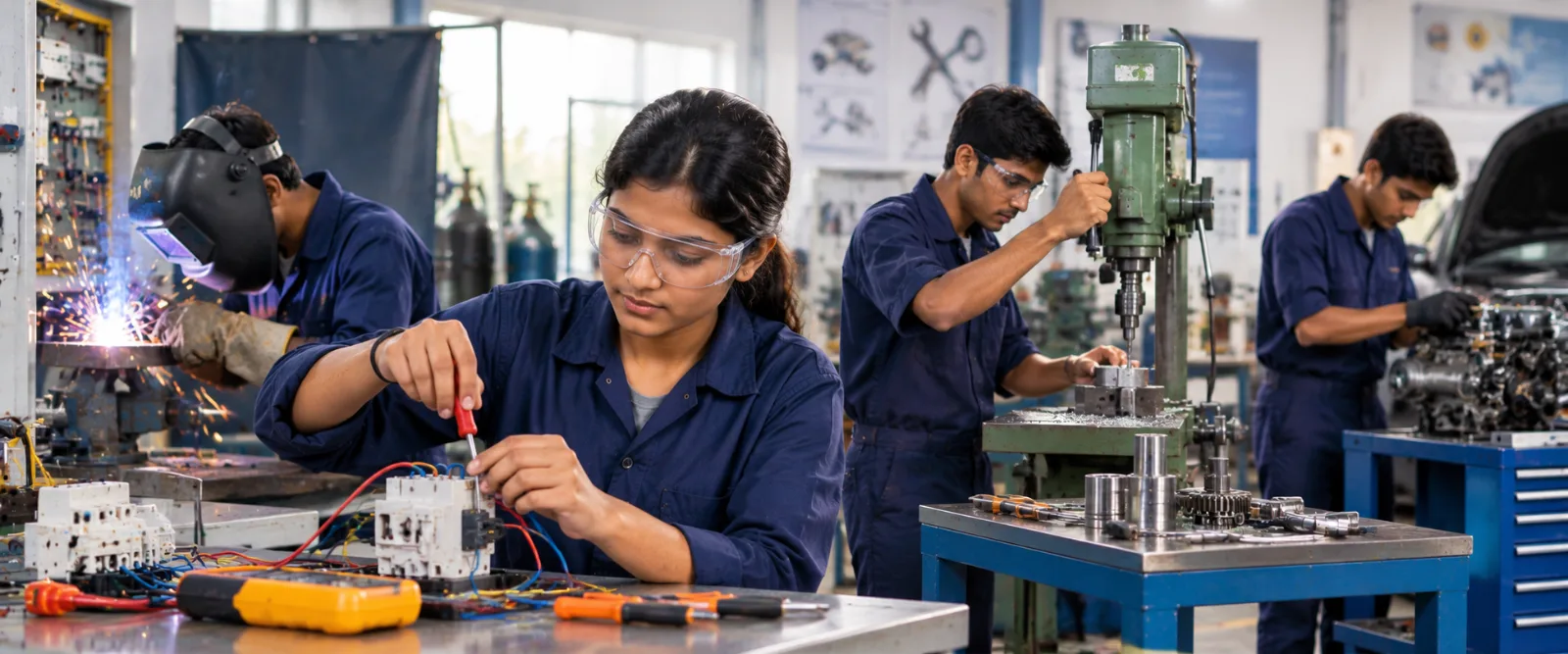
A student who enjoys hands-on work may find this route attractive. Depending on the trade, training can involve tools, machines, electrical systems, fabrication, maintenance, electronics, vehicles or other practical tasks.
ITI can be a good fit if you want focused trade skills and would like to build workplace experience through a relatively focused training route.
In India, ITI training is delivered under the Craftsmen Training Scheme through Industrial Training Institutes. DGT describes CTS as a vocational training scheme intended to develop skilled workers for industry and provide employable skills. Current CTS training covers a wide range of NSQF-compliant trades, including both conventional and newer occupational areas.
What is a Diploma?
A polytechnic diploma generally provides technical education in a broader discipline such as Mechanical, Electrical, Civil, Electronics or Computer-related fields.
Government material on polytechnic education describes conventional diploma programmes as generally three years after Class 10, while institutions also offer newer and specialised disciplines.
Compared with an ITI trade, a diploma usually involves a wider mix of mathematics, engineering concepts, theory, practical work and technical subjects.
The biggest difference is the type of learning
Think of the difference this way:
ITI: 'I want to learn a specific skill or trade and become good at doing the work.'
Diploma: 'I want broader technical knowledge in a particular engineering or technical discipline.'
There is overlap. ITI is not only practical, and diploma is not only theory. Both include practical learning. The difference is mainly in the breadth and structure of the education.
Which is better for getting a job?
There is no single answer. Job opportunities depend on the trade or diploma discipline, employer requirements, location, experience and the skills you can demonstrate.
An ITI graduate may be a strong fit for a vacancy that specifically requires a trade qualification and hands-on ability. A diploma holder may fit roles where the employer asks for a diploma in a particular engineering discipline.
The best approach is to look at actual job descriptions for the work you want to do. Notice the qualification, skills, tools, software, experience and location employers are asking for.
Choose ITI if...
You enjoy practical, hands-on work.
You already have an idea of the trade you want to learn.
You want focused vocational training.
You are comfortable learning through workshop and practical activities.
You want to start building trade-specific work experience after a focused training route.
Choose Diploma if...
You want broader technical education in a discipline.
You are comfortable with mathematics and technical theory along with practical work.
You want to explore a wider range of technical roles within a discipline.
You are considering further technical education.
You are interested in the broader engineering or technical side of a field.
Can an ITI student continue studying later?
Yes. An ITI qualification does not have to be the end of formal learning. Further study and career progression depend on the trade, qualification, institution and applicable rules.
DGT also lists pathways around academic equivalence and career progression in the vocational training ecosystem. Check current admission and equivalence rules rather than assuming that every ITI route leads to the same next qualification.
What about apprenticeship?
Apprenticeship can be useful after either route where the relevant programme accepts the qualification. For ITI candidates, trade apprenticeship can provide practical workplace exposure. For eligible diploma engineering pass-outs, NATS provides a separate apprenticeship route.
Always check current eligibility and apprenticeship rules before applying.
A simple way to decide
Ask yourself: Do I enjoy working with tools, machines or equipment? If yes, ITI may be a natural fit.
Do I already know the trade I want to learn? If yes, ITI may give you a focused starting point.
Do I want broader technical education? If yes, Diploma may be worth considering.
Am I comfortable with more technical theory and mathematics? If yes, Diploma may suit you better.
Do I want to keep studying in a technical discipline? Compare the further-study options available for the specific programme.
The important part is what you do after the qualification
The qualification matters, but it is only one part of a career. Practical ability, safety, communication, reliability, workplace behaviour and willingness to learn all matter once you enter the workforce.
An ITI student who keeps building skills can grow into more responsible technical roles. A diploma holder who gains practical exposure can also build a strong technical career.
Final answer: ITI or Diploma?
If you want focused, trade-based vocational training and enjoy hands-on work, ITI can be a very practical choice.
If you want broader technical education in a discipline and are comfortable with a longer, more academic technical programme, a diploma may be a better fit.
Instead of asking which one is better for everyone, ask: 'Which one is better for the kind of work I want to do?' That question usually leads to a more useful decision.
Related Articles
 ★ Featured
How to Get Your First ITI Job: A Practical Guide for Freshers
Just finished your ITI course? Here's a step-by-step guide to landing your first ITI job — building a job-focused resume, finding the right roles, using apprenticeships and NAPS-2, acing technical interviews, and a simple 30-day plan to get hired faster.
 ★ Featured
Best Way to Find ITI Jobs: Job Portals vs Direct Applications vs Placement Cells
Looking for an ITI job? Compare job portals, direct applications and institute placement cells to understand where to look and which approach may work best for you.
 ★ Featured
Best ITI Trades for Jobs in India: How to Choose the Right One
Which ITI trade should you choose? Explore popular ITI trades and learn how to choose the right one based on your interests, skills, career goals and future opportunities.